Mar 25, 2026
Articles
Rhetoric, Recovered: Education in the Age of AI
On making thought visible again
Haley Moller
Co-founder & CEO
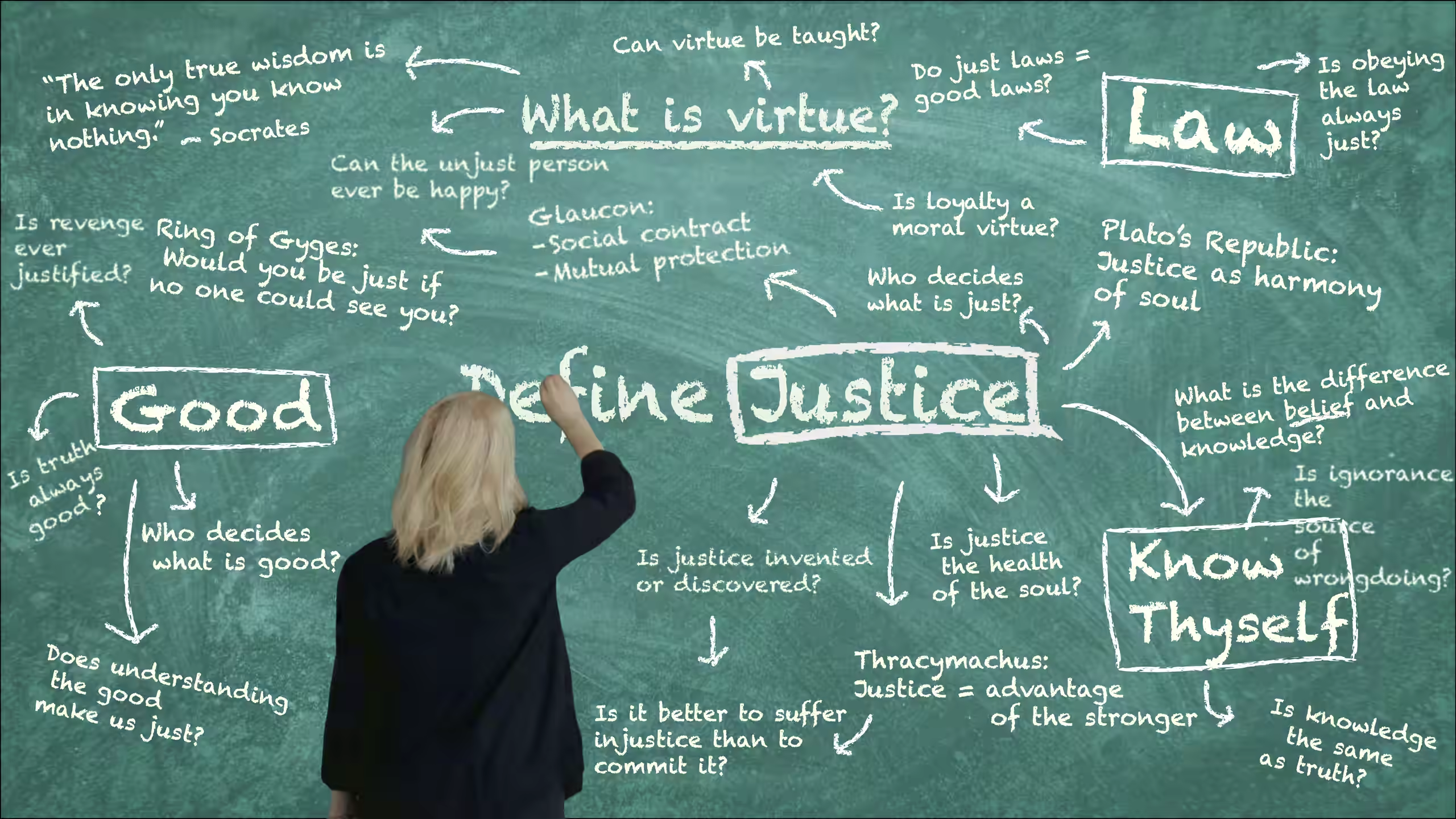
There was a time when education was not mainly about producing the “right” answer. It aimed at something harder to measure, and more human: the formation of a mind. Students were taught not just what to say, but how to test a thought, weigh it, follow it, and finally claim it honestly. At the center of that ideal was rhetoric.
Rhetoric, properly understood, is the art of making judgment public. It asks a person to make a claim, support it with evidence, and face resistance. It requires, when necessary, that the claim be revised rather than defended past the point of sense. It is not the performance of certainty, but the discipline of discovering whether what one believes can actually be defended.
That understanding matters now with unusual force, because we live in a moment when fluent answers can be produced on demand. Artificial intelligence can arrange sentences elegantly and assemble familiar points in minutes. This does not eliminate the need for thought. It exposes how often we confused its outward signs with the thing itself. If a machine can produce the artifact, then the artifact can no longer be the point. We are pushed back to a more basic question: What does it mean for a student to think?
Rhetoric offers a clear answer. To think rhetorically is not simply to have an opinion. Opinions are easy. Thinking begins when an opinion is put under pressure. A claim must be clear enough to be challenged, evidence strong enough to hold, and reasoning visible enough for another mind to follow and dispute. Alternatives cannot be dismissed because they are inconvenient. In that process, thought becomes inquiry rather than declaration. One discovers, often uncomfortably, what one is actually prepared to stand behind.
This is why rhetoric once stood near the center of education. In the ancient world, it was bound to philosophy. Dialogue was a diagnostic—a way of exposing belief. Confidence would falter, contradictions would emerge, and what first appeared obvious would prove fragile. This was not failure; it was instruction. The movement from certainty to precision is one of the central experiences of intellectual life.
For centuries, education retained some memory of this. Students were expected not just to absorb texts, but to contend with them—to interpret, defend, and dispute. The goal was not fluency alone but accountability of mind. A student's words were meant to reveal the judgment beneath them.
Then came a gradual shift, driven by scale. As systems grew, older forms of evaluation became difficult to sustain. Oral examination takes time; genuine argument resists standardization. The essay emerged as a practical substitute. It could be read, compared, and graded efficiently.
But substitutes forget what they replace. Over time, many students learned to produce the appearance of reasoning without undergoing its demands. They mastered structure, citation, and tone. They learned how to resemble understanding. The system began, often unintentionally, to reward polish over depth and correctness over curiosity. The product remained; the struggle that should have produced it became optional.
Artificial intelligence did not create this weakness, but it did help reveal it. When a model can generate a coherent essay in seconds, the essay can no longer stand as evidence that thinking has occurred. This is not only a problem of integrity; if our methods reward what can be easily generated, they were already misaligned with the purpose of education.
This does not mean writing no longer matters. It matters very much. But writing must again be understood as an expression of thought, not a substitute for it. If we want to know whether a student can reason, we must attend to the process by which an idea is formed, tested, revised, and sometimes abandoned. We must create conditions in which students cannot skip the uncertainty that makes conclusions meaningful.
This is where rhetoric becomes indispensable. To teach rhetoric is to attend to thought in motion. A student must commit to a claim, ground it in evidence, explain the connection, face challenge, and revise when necessary. This work is often halting and sometimes frustrating, but it is far more revealing than the smooth confidence of a finished paragraph. Precisely because it is unfinished, it shows where learning actually occurs.
Most contemporary AI edtech tools are not designed for this. They are designed to help—offering hints, scaffolds, and partial answers. Such support can be useful, but it can also obscure the very thing we need to see. When the system supplies the interpretation and closes the gap, the result may look successful while concealing how little of the intellectual burden the student carried. Assistance is not assessment.
Socra begins from a different premise: that students learn to think by being required to think. Instead of steering them toward predetermined responses, it asks them to say what they believe, point to evidence, explain their reasoning, and respond to challenge. Most importantly, the student must answer before the system proceeds. The exchange is not designed to replace reasoning, but to call it forth.
That distinction is small in appearance but large in consequence. Many tools remove friction. Socra makes thought visible, even when it is partial or wrong. Those moments are not failures to be hidden; they are the substance of learning itself. While a polished answer can conceal confusion, a live exchange makes that harder.
This matters for teachers as well, since thinking is usually invisible. Final work does not show where a student hesitated, what they considered and abandoned, or when an assumption gave way. Socra captures this movement. What emerges is not just a conclusion, but a record of reasoning. The question is no longer whether the answer sounds convincing, but how the student arrived there.
The stakes extend beyond school. Rhetoric is not just an academic skill. It is a way of living with competing claims, uncertain information, and difficult decisions. To think rhetorically is to question without cynicism, evaluate without false certainty, and revise without surrendering conviction. These are not decorative capacities. They are part of what seriousness requires.
Seen this way, Socra is less an invention than a recovery. It returns to a first principle: that education should make thinking visible and answerable. What is new is not the ideal, but the ability to pursue it at scale. AI can either bypass reasoning or require it. The difference is design.
So we are left with a simple question. What do we value? If we value answers alone, machines will provide them with increasing brilliance. But if we value the harder, more human work of thought, then we must teach students to argue, justify, and endure revision. That has always been the work of rhetoric. It is the work we need to return to now.